Indoor Air Quality and Secondary Organic Aerosols
Some seemingly innocuous things (like lemon scent) under the right conditions can seriously hurt indoor air quality through the creation of particulates. This activity shows their creation and allows you to measure them in a variety of conditions.
Materials
- SEN 66 Air Quality Measuring Device developed by the Teacher Institute
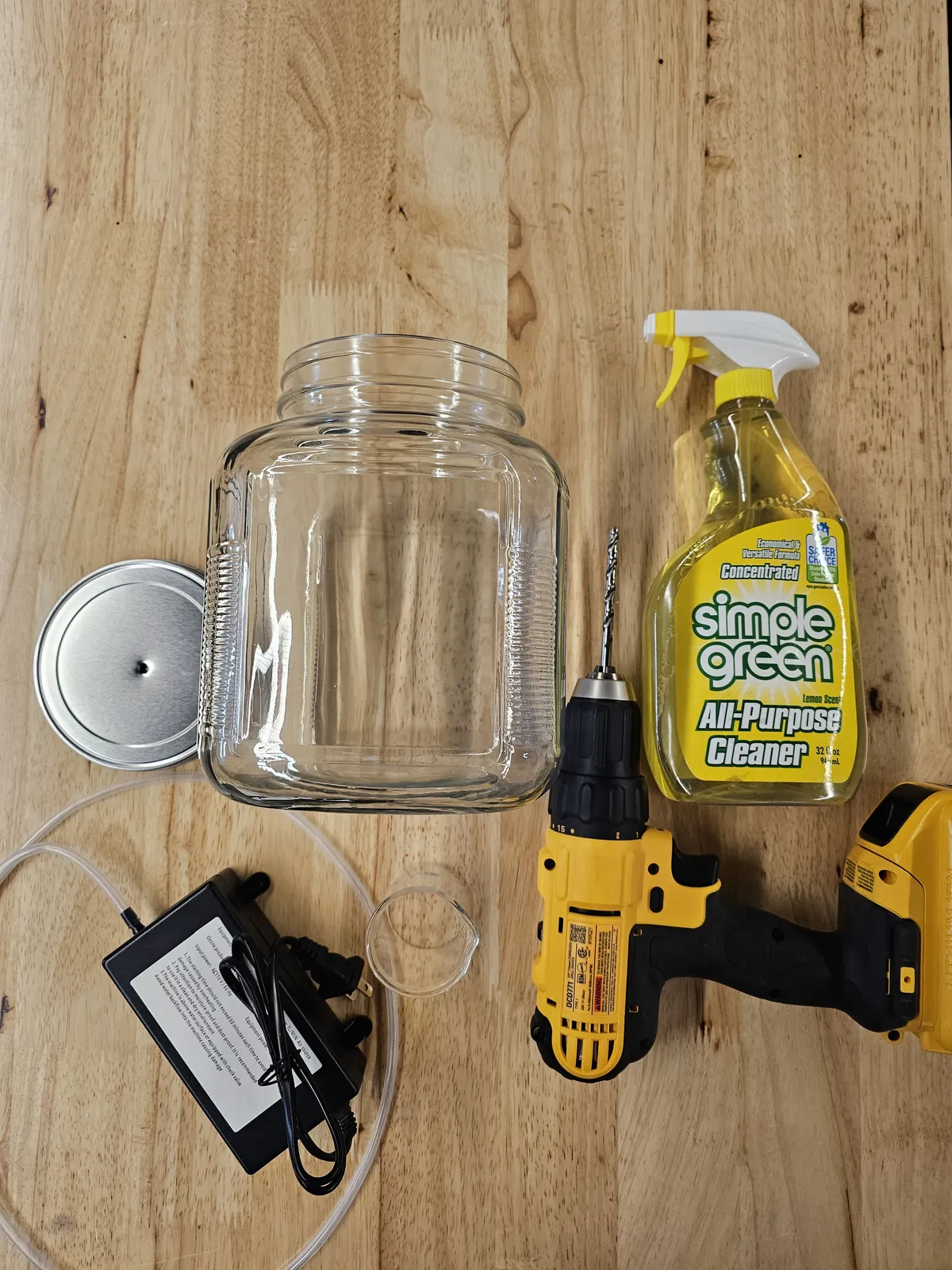
- Concentrated lemon scented cleaning product like Simple Green Lemon Scent All-Purpose Cleaner
- 1 gallon (4 L) jar with a metal or plastic lid
- small 100 ml or similar container
- small ozone generator like this one with aquarium tubing
- drill and drill bit to fit the tubing (it doesn't have to be precise)
- electrical or other tape (optional)
- balloon pump like this one (optional)
To Do and to Notice
Drill hole in the lid of the jar. The drill bit must make a hole larger than the tube, but a precise fit isn't essential. If the hole is too big, just wrap the tube with tape. The ozone generator is pumping air into the jar, and it will eventually find its way out.
Place the sensor into the jar. Arrange it so that you can see the screen through the wall of the jar, but keep the screen on the top. The sensor will have a longer life if the sensor faces sideways. If you are planning on collecting data, start the collection in phyphox.
Replace the top and let the sensor reach equilibrium. Due to how the app graphs data, it can look like it is jumping around more than it is. For particulates, the sensor has an error range of about 1 μg/m³, and a precision of only 10%. The CO₂ output is plus or minus 50 ppm, and the VOC Index tends to jump around by several percent. So small changes are probably not real.
Spray several milliliters of the cleaner into to a cup or small beaker. Place the cup into the jar and replace the lid. Observe what's going on. The VOC level will probably suddenly shoot up and may even hit its maximum of 500 units. But pay attention to the other values. Notice that the particulates might have changed a little but probably not too much. The CO₂ may have not changed at all.
Turn on (plug in) the ozone generator. You will probably see a few small changes: Maybe a small bump in the particulate counts, maybe a small change in carbon dioxide and VOC. This shouldn't be too surprising; you are pumping air from a dirty tube into the jar, but the changes shouldn't be too big.
After a bit, you should start to see much bigger changes. The first thing you'll notice is a bigger change in the VOCs. Then, you should see a huge change in the particulates.
What's Going On
Simple Green like many cleaners contains a naturally derived chemical called limonene which most people thinks has a pleasent citrus aroma, sort of like lemon, lime, orange, or, in my opinion, lemongrass.

As you can see, limonene is a small molecule, C10H16, and non-polar. Since small non-polar molecules don't stick strongly to themselves, limonene readily escapes into the air. This is a volatile organic compound (VOC). There are lots of others.
Here's some sample data to compare to yours.
This is some data from my test run. Compare it to yours.
You can see the particulate data starts very close to zero. That might not be true for you, but we were doing this activity inside the Exploratorium which has amazingly clean air.
So it isn't surprising that the VOC level shot up around when the cleaner was added (at 100 s in my run). What you might have found surprising is that the level went down later after you turned on the ozone generator (at about 200 s in my run).
Part of the situation is that the ozone generator is pumping gas into the jar, so the concentration goes down some.
A bigger reason is that the ozone attacks the limonene. Ozone is like very reactive oxygen and changes the limonene into a variety of different products. The important bit is that these products aren't as non-polar and sometimes fairly polar. Those particles stick together to make bigger and bigger particles.
That's why at first the particle count doesn't change that much. The particles are too small for the detector to measure. Once they get above a micrometer or so, the detector can see them, and the particulate counts will explode upwards.
That will bring down the VOC levels since they are being turned into particles instead.