Inexpensive Carbon Dioxide and Particulate Matter Sensor
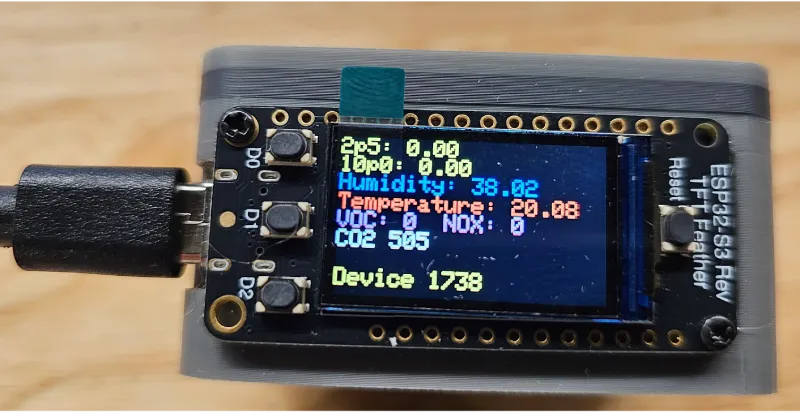
Building HVAC is starting to use more and more sensors to improve ventilation, and the air quality sensor companies are developing cheap sensors that can take good enough data. Though not research grade, they have the advantage of being cheap (less than US$100), making them well suited for the science classroom.
Materials
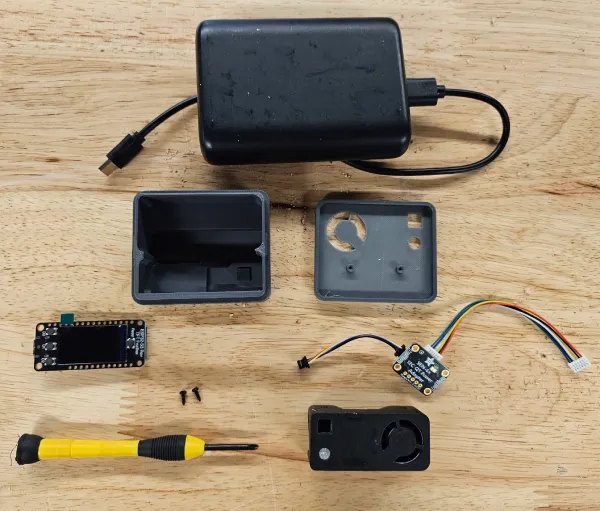
SEN-66 sensor This sensor detects CO2, PM 2.5 (and other ranges), temperature, humidity, VOC, and NOx. It will connect with any device that can read the I2C protocol, but is most frequently used with a ESP32 microcontroller.
Adafruit Feather ESP32 TFT Reverse As of writing this, it isn't available at Adafruit, but is available on Digikey and other sites. Any ESP32 will work with it, but like Adafruit and I find the built-in display handy.
3D printed housing box and cover (Should work with any 3D printer.)
M1.7 or M2 self-tapping screws
Small Phillips head screwdriver
USB C cable (Either C to C or A to C works.)
Power bank with the appropriate connector that you are using above
Assembly
Download the Arduino IDE and stall it on your computer. There is a cloud version as well, and you can install that instead. It's a little bit easier to use but doesn't work on every system as well.
The latest version of the software for the Feather is here.
Using the six pin cable, connect the Sen66 to the small breakout board. Then use the 4 pin cable to connect the breakout board to the Feather.
Using a USB C cable, connect the Feather board to your computer. Compile and download the software to the Feather. A lot was just included in those two sentences, but Adafruit has lots of help.
Note: The Feather, like many ESP32 boards, may not automatically start after you download the software. You may have to press the reset button on the Feather if the download completes but nothing displays on the screen.
It will take a minute before anything is displayed on the screen, and it will take several more minutes before the data is meaningful.
The Sen66 is not a research grade product. Its specs can be found on its datasheet. From our experience, two different sensors might display quite different values, but smaller changes in values on a single instrument are more likely to be real. Simply: For particulates, differences of about 2 μg/m³ are real, but the sensor has an accuracy of only 10%. The CO₂ output is plus or minus 50 ppm, but 20 ppm difference on the same unit is probably a real change. The VOC Index tends to jump around by several percent. Only changes of more than 20 points are probably real.
Using a 3D printer, make the case and top. You'll need to detach the Feather from the 4 pin cable to so that it can go through the hole. The pictures should help you align the parts.
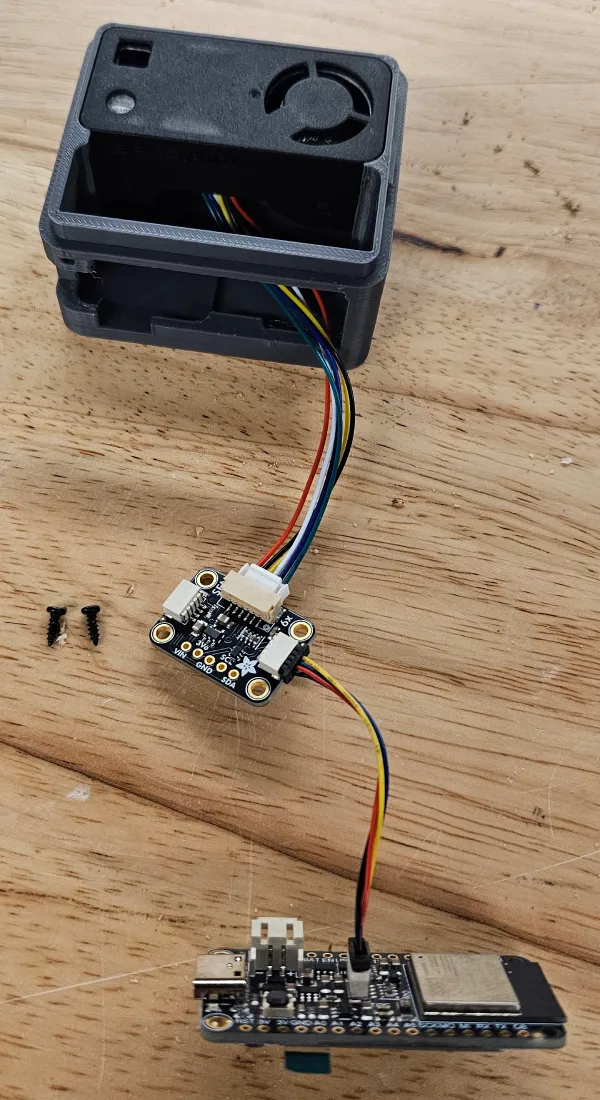
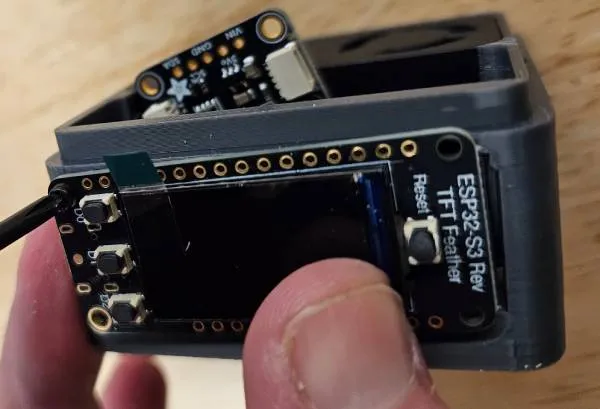
Don't over tighten the screws! Tolerances on 3D prints can be wonky and for things this small it can be tricky. It will probably just barely fit. If there's a small gap, don't worry.
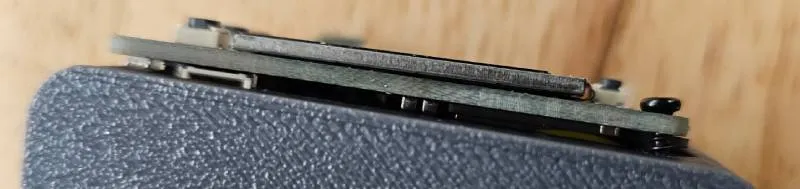
- Tighten a bit more, but if you see the board bending, STOP!
To Do and Notice
Connect the board to a power bank! Wander around. Go inside and outside. Breath on it.
The Sen66 and the Feather can update pretty quickly, but it needs several minutes to warm up.
You will probably notice that your breath will rapidly drive up the CO2 level and increase the particulates a little and the VOCs more. Not surprising really since you breath out carbon dioxide, have few particulates on your breath, and have many VOCs in your mouth. The sensor will usually go back down before too long.
Connecting to phyphox
Your sensor has a device name at the bottom. Note that value.
Open phyphox on your device.
From the main screen, press the + button. On most devices it is on the bottom right.
You should get this screen:
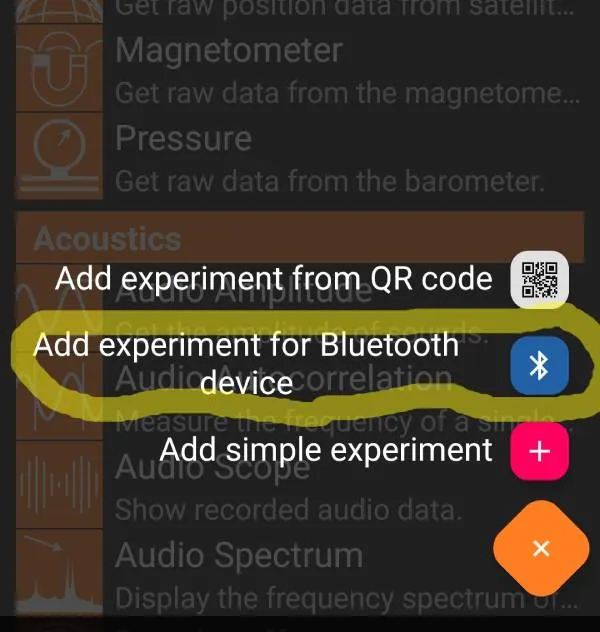
Select the middle option "Add Experiment for Bluetooth Device". phyphox will now offer you options to connect to nearby Bluetooth devices. Select the one with the same number as the number on the device's screen.
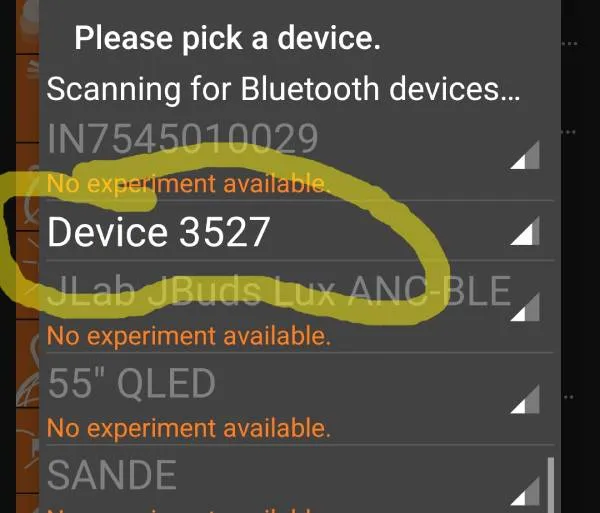
You should then get this screen:
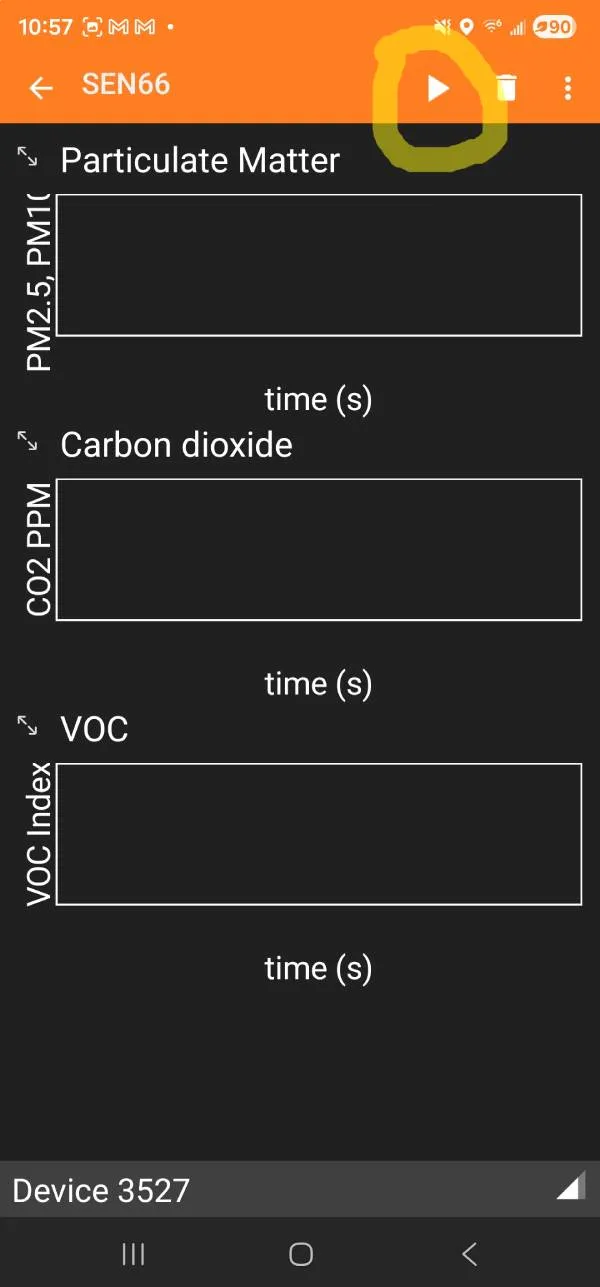
Press the marked button to start collecting data! You can save, download, and share the data. The only downside is that if you switch away from the app, it will stop collecting data.